



Epigenetics
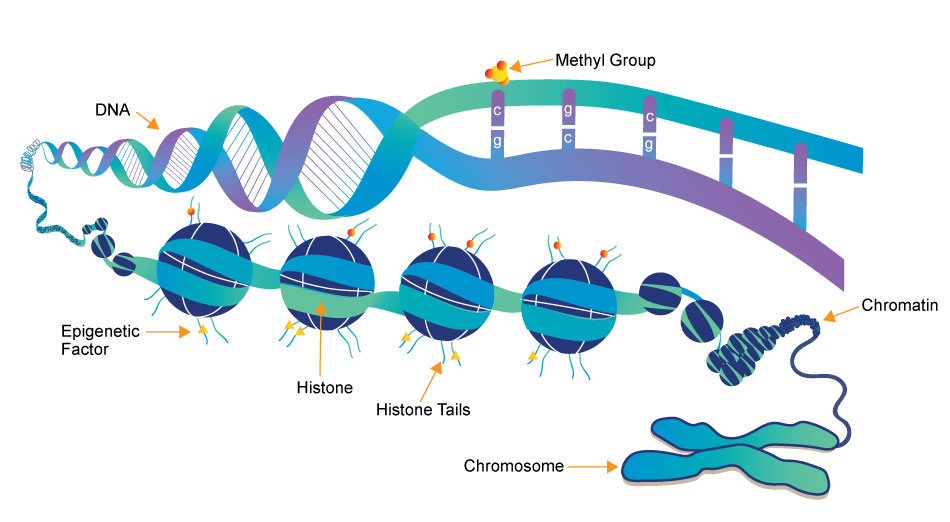
Epigenetics research delves into the molecular mechanisms that control gene expression and cellular traits without altering the underlying DNA sequence. One crucial aspect of this field is the role of small molecules, which act as powerful regulators of epigenetic modifications. These small compounds, typically comprising a few dozen to a few hundred atoms, have emerged as essential tools in understanding and manipulating the epigenome.
- DNA Methylation Inhibitors: Small molecules like 5-azacytidine and 5-aza-2'-deoxycytidine are DNA methyltransferase inhibitors. They block the addition of methyl groups to DNA, leading to DNA demethylation. This can reactivate silenced genes, potentially offering therapeutic avenues for conditions like cancer.
- HDAC inhibitors: HDACs remove acetyl groups from histone proteins, contributing to gene repression. Small molecule HDAC inhibitors, such as Vorinostat and Romidepsin, can reverse this process by increasing histone acetylation, allowing genes to be more accessible for transcription. These inhibitors are being explored for cancer therapy and other conditions.
- Histone Methyltransferase Inhibitors: Small molecules like GSK126 inhibit specific histone methyltransferases, affecting histone methylation patterns. This can alter gene expression, making them promising candidates for cancer and other diseases with epigenetic dysregulation.
- RNA Modulators: Small molecules can also target non-coding RNAs involved in epigenetic regulation. For instance, small molecules called small interfering RNAs (siRNAs) can be designed to target and degrade specific long non-coding RNAs, influencing gene expression.
- Epigenetic Reader Domain Inhibitors: These small molecules target proteins that recognize and bind to specific epigenetic marks. Examples include inhibitors of bromodomain-containing proteins (BET inhibitors), which can disrupt gene regulation by interfering with protein-DNA interactions.
Small molecules in epigenetics research not only provide insights into the fundamental biology of gene regulation but also hold immense promise for developing novel therapeutics. Their ability to selectively modulate specific epigenetic marks and pathways has led to ongoing clinical trials and drug development efforts for various diseases, including cancer, neurological disorders, and inflammatory conditions. Understanding and harnessing the power of these small molecules is at the forefront of modern epigenetics research, offering new hope for precision medicine and targeted therapies.
3 key components involved in the regulation of epigenetic modifications
Epigenetics Writer
Epigenetics writers are enzymes responsible for adding chemical marks or modifications to DNA or histone proteins. These marks include DNA methylation (addition of methyl groups to DNA) and histone modifications (such as acetylation, methylation, phosphorylation, etc.).
Epigenetics Reader
Function: Epigenetics readers are proteins that can recognize and bind to specific epigenetic marks on DNA or histones. These reader proteins interpret the epigenetic code and facilitate downstream cellular processes, such as gene activation or repression.
Epigenetics Eraser
Function: Epigenetics erasers are enzymes responsible for removing or reversing epigenetic marks on DNA or histones. This process allows for the dynamic regulation of gene expression and the resetting of epigenetic states during various stages of development and in response to environmental changes.
-
Src/Abl 抑制剂
Saracatinib (AZD0530) 是一种高度选择性的、可口服的双特异性 Src/Abl 激酶抑制剂,其对 c-Src 和 Abl 激酶的 IC50 分别为 2.7 nM 和 30 nM。- Andromachi Lambrianidou, .et al. , Cell Signal, 2021, Apr;80:109912 PMID: 33388443
- Chisato Naito, .et al. , Atherosclerosis, 2016, Mar;246:344-51 PMID: 26828753
- Kenta Maruyama, .et al. , J Biol Chem, 2015, Apr 10; 290(15): 9377-9386 PMID: 25691576
- Amanda L Jackson, .et al. , Expert Opin Emerg Drugs, 2015, Jun;20(2):331-46 PMID: 26001052
-
Src 抑制剂
Bosutinib (SKI-606) 是一种酪氨酸激酶抑制剂,正在研究中用于治疗癌症。- Li Li, .et al. , Leukemia Res, 2019, 78:12-20 PMID: 30660961
-
Abl-Src 抑制剂
Dasatinib(BMS-354825)是一种口服多效 BCR/ABL 和 Src 家族酪氨酸激酶抑制剂。Dasatinib 的主要靶点包括 BCR/ABL、Src、c-Kit、ephrin 受体以及其他几种酪氨酸激酶,但不包括 erbB 激酶,如 EGFR 或 Her2。- Hiroyasu Aoki, .et al. , Cell Rep, 2024, Mar 26;43(3):113887 PMID: 38458195
- Hiroto Kataoka, .et al. , Anal Biochem, 2023, Oct 1;678 PMID: 37541642
- Vijaya Bharti, .et al. , Cell Rep, 2022, Dec 20;41(12):111826 PMID: 36543138
- Chihiro Motozono, .et al. , Nat Commun, 2022, Sep 21;13(1):5440 PMID: 36130929
- Aya Hasan Alshammari, .et al. , Biochem Pharmacol, 2022, Mar;197:114914 PMID: 35041812
- Adi Jacob Berger, .et al. , Nat Cancer, 2021, 2, 1055-1070 PMID: 35121883
- David E J Klawon, .et al. , J Exp Med, 2021, Jun 7;218(6) PMID: 33914024
- Reiko Watanabe, .et al. , J Med Chem, 2021, Mar 11;64(5):2725-2738 PMID: 33619967
- Li Li, .et al. , Leukemia Res, 2019, 78:12-20 PMID: 30660961
- Sano T, .et al. , Am J Pathol, 2018, Nov;188(11):2564-2573 PMID: 30121259
- Ines Peschel, .et al. , Haematologica, 2017, Aug; 102(8): 1378-1389 PMID: 28522571
- Brittany M. Duggan, .et al. , Sci Rep, 2017, 7: 1578 PMID: 28484277
- John D. Leonard, .et al. , Immunity, 2017, Jul 18; 47(1): 107-117.e8 PMID: 28709804
- Fujita KI, .et al. , J Pharm Sci, 2017, Sep;106(9):2632-2641 PMID: 28479358
-
EphB4 抑制剂
NVP-BHG712 是一种选择性的 EphB4 激酶 抑制剂,在体外对 EphB4 的选择性优于40多种其他激酶,包括 FGFR3。- Ryuzaburo Yuki, .et al. , Eur J Pharmacol, 2024, Jan 15:963:176229 PMID: 38072041
- Y Kaibori, .et al. , the FASEB Journal, 2019, Jan 22:fj201801519RR PMID: 30668924
-
MAO-B 抑制剂
槲皮素能够抑制多种酶系统,包括酪氨酸蛋白激酶、磷脂酶A2、磷酸二酯酶、线粒体ATP酶、PI 3-激酶和蛋白激酶C。- Sumayyah Saeed, .et al. , Int J Mol Sci, 2025, Jan 14;26(2):654 PMID: 39859369
-
Src 抑制剂
KX2-391 2Hcl 是首个临床级Src抑制剂(肽类模拟物),它针对Src的肽底物位点,其在癌细胞系中的GI50为9-60纳摩尔。 -
Src tyrosine kinase 抑制剂
Src Inhibitor 1 是一种强效且选择性的双位点 Src 酪氨酸激酶抑制剂,其 IC50 值分别为针对 Src 的 44 nM 和针对 Lck 的 88 nM。 -
Src 抑制剂
Dasatinib hydrochloride 是一种强效的双重 Abl/Src 抑制剂,其 IC50 分别小于1 nM和0.8 nM;同时也能抑制 c-Kit (WT)/c-Kit (D816V),其 IC50 分别为79 nM和37 nM。 -
Lck 抑制剂
Lck inhibitor 2 是一种双苯胺嘧啶抑制剂,能够抑制包括 LCK、BTK、LYN、SYK 和 TXK 在内的酪氨酸激酶。其半抑制浓度(IC50)分别为 LCK 13nM、BTK 9nM、LYN 3nM、SYK 26nM 和 TXK 2nM。 -
VEGFR2/Src kinase 抑制剂
TG 100572 是一种多靶点激酶抑制剂,能够抑制选择性生长因子受体酪氨酸激酶和Src家族激酶,其 IC50 值分别为 VEGFR1/VEGFR2/FGFR1/Src/Fyn 激酶的 2/7/2/1/0.5 nM。 -
Src 抑制剂
T338C Src-IN-1 是一种强效的突变型Src T338C抑制剂;相对于野生型c-Src,展示出对T338C的最强抑制作用(IC50=111 nM),抑制效果提高了10倍。 -
Src 抑制剂
T338C Src-IN-2 是一种强效的突变型 c-Src T338C 激酶抑制剂,其 IC50 为 317 nM;同时也能抑制 T338C/V323A 和 T338C/V323S,其 IC50 分别为 57 nM 和 19 nM。 -
Lck 抑制剂
KIN001-051 是一种强效且选择性的 lck 抑制剂。淋巴细胞特异性蛋白酪氨酸激酶(Lck)是 Src 家族非受体蛋白酪氨酸激酶的成员之一,它在 T 细胞受体信号传导的初始步骤中发挥关键作用,这些信号传导触发细胞因子的产生。 -
SRC 抑制剂
CSF1R-IN-2(化合物5)是一种口服活性的SRC、MET和c-FMS抑制剂,其IC50值分别为SRC 0.12 nM、MET 0.14 nM和c-FMS 0.76 nM。 -
Src 抑制剂
Tirbanibulin Mesylate(KX2-391 Mesylate)是一种Src抑制剂,它针对Src的肽底物结合位点,其在癌细胞系中的GI50为9-60 nM。 -
Src/c-Abl 抑制剂
1-萘基PP1盐酸盐是一种选择性抑制剂,主要针对src家族激酶v-Src和c-Fyn以及酪氨酸激酶c-Abl(IC50值分别为v-Src 1.0 μM、c-Fyn 0.6 μM、c-Abl 0.6 μM、CDK2 18 μM和CAMK II 22 μM)。
